Selected work in organizational communication, human–machine communication, collaboration, and digital life.
The figures and tables below show questions, relationships, and findings from papers I coauthored.
From the papers
Models and results.
Open either figure to see the labels at full size. The visual on small screens scrolls horizontally.
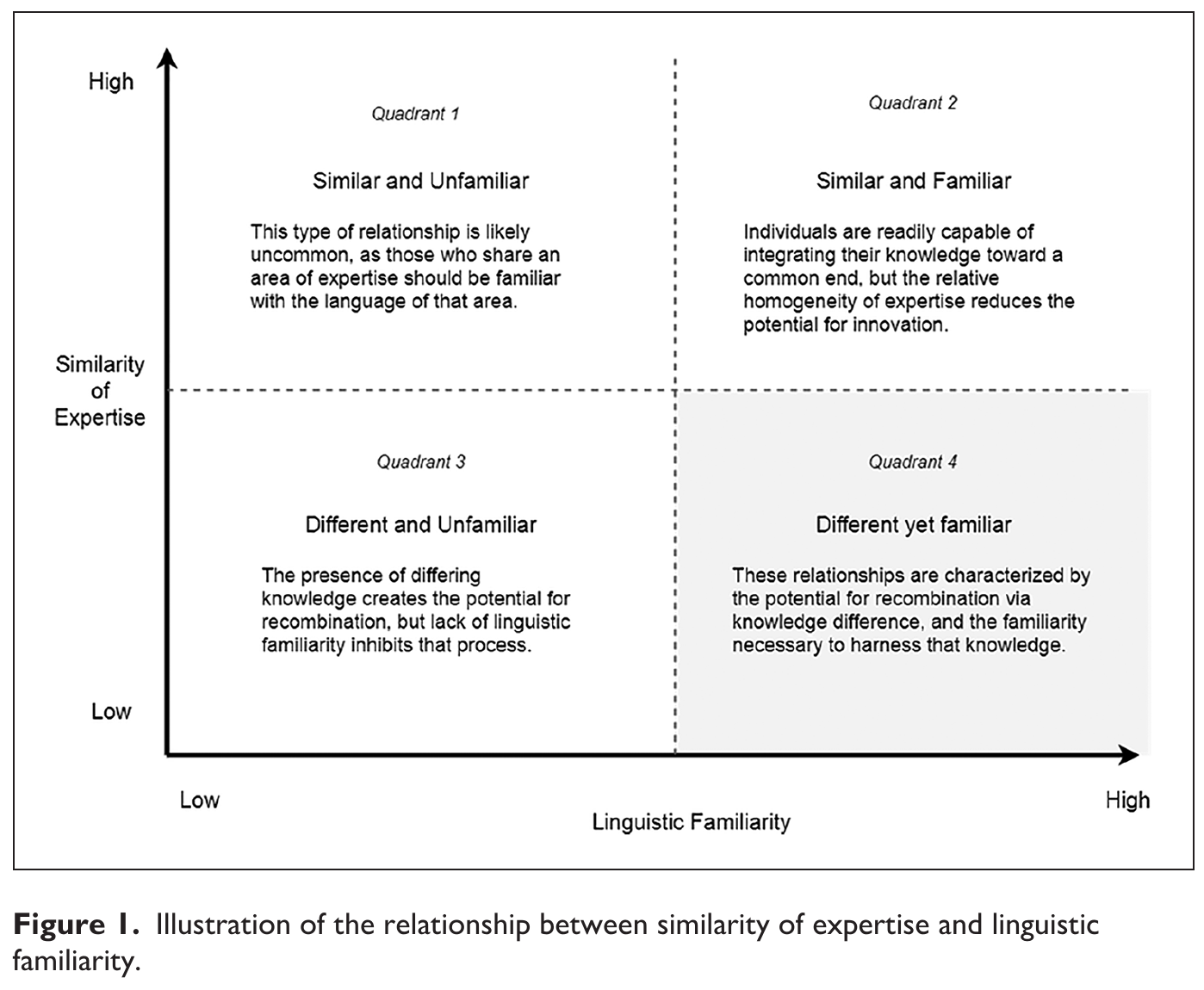
What kind of tie helps knowledge cross a boundary?
Barley, Dinh, Workman, and I distinguished the similarity of collaborators’ expertise from their familiarity with one another’s language. The lower-right quadrant is the difficult but promising case: different expertise with enough linguistic familiarity to make knowledge usable.
Figure 1 from Barley, Dinh, Workman, & Fang (2022), Communication Research. Read the article ↗
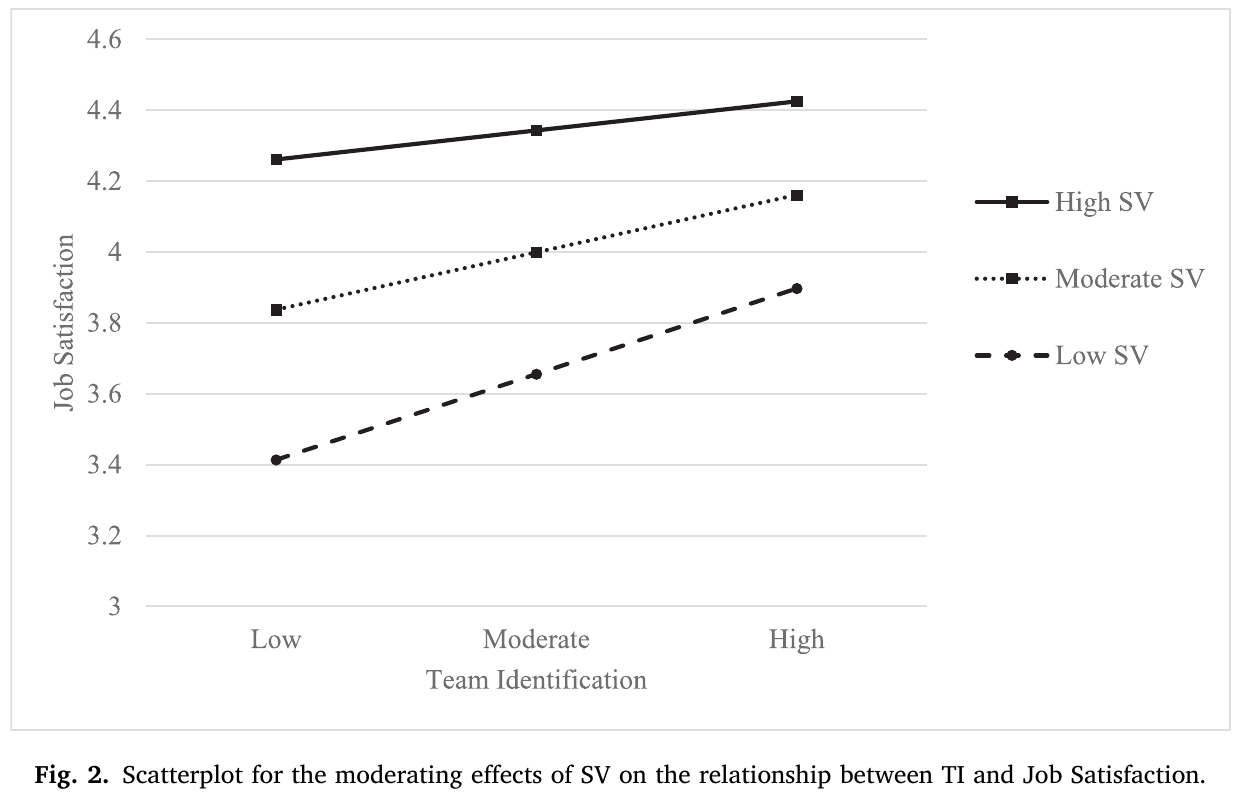
What helps global contractors feel connected to their work?
In a study of offshore IT professionals, team identification and shared vision were associated with job satisfaction. The fitted lines show that high shared vision especially helps when identification with the team is low.
Figure 2 from Gibbs, Eisenberg, Fang, & Wilkenfeld (2023), Journal of International Management. Read the article ↗
How do people position generative AI in relation to themselves?
Kim, Zhang, and I identified three ways participants drew the human–AI boundary. The table keeps the boundary claims and corresponding practices together.
Boundary
How GenAI is framed
Common practice
Complementary
Different from human intelligence, yet useful for capabilities such as retrieval and efficiency.
Active, relatively unrestricted engagement across tasks.
Competitive
Different from humans and seen as lacking capacities such as intuition, creativity, or empathy.
Non-use or calls for regulation.
Co-evolving
The line between human and AI intelligence is understood as changing through interaction.
Reflective collaboration, including sequencing, compartmentalizing, and training.
Adapted in shorter form from Table 1 in Kim, Zhang, & Fang (2025), Computers in Human Behavior: Artificial Humans. Read the article ↗
Why did legal professionals read the same technology differently?
In our study of legal work, professional roles drew on different institutional logics when assessing intelligent technologies. The table shows the main patterns in this sample, from lawyers’ emphasis on expertise to law librarians’ concern with access and legal staff members’ attention to efficiency.
Role
Salient logic
View of legal work
Orientation to intelligent technologies
Lawyers
Expertise
Complex and subjective work grounded in experience, ethics, and professional judgment.
Generally resistant in this sample.
Law librarians
Accessibility
Information seeking and making legal knowledge accessible.
Supportive while attentive to benefits and limits.
Legal staff & students
Efficiency
Clerical work and effective use of legal research tools and processes.
Generally supportive in this sample.
Condensed from Table 3 in Fang, Wilkenfeld, Navick, & Gibbs (2023), Management Communication Quarterly. Read the article ↗
Selected publications
Read the papers.
These selected papers link to their journal pages or open-access versions.
2026
Exploring personal digital media environments: A configural approach to digital stress
Frontiers in Psychology · with Ceciley Xinyi Zhang and Ronald E. Rice
Treats a person’s media as an interconnected environment to examine how its configuration relates to digital stress.